
Ground Nests
Underground Wasp Nest
A single hole in the lawn with a constant stream of wasps in and out is the classic sign of an underground nest. These are the highest-risk nests for accidental disturbance — and the easiest for us to treat. Call 01727 789571.
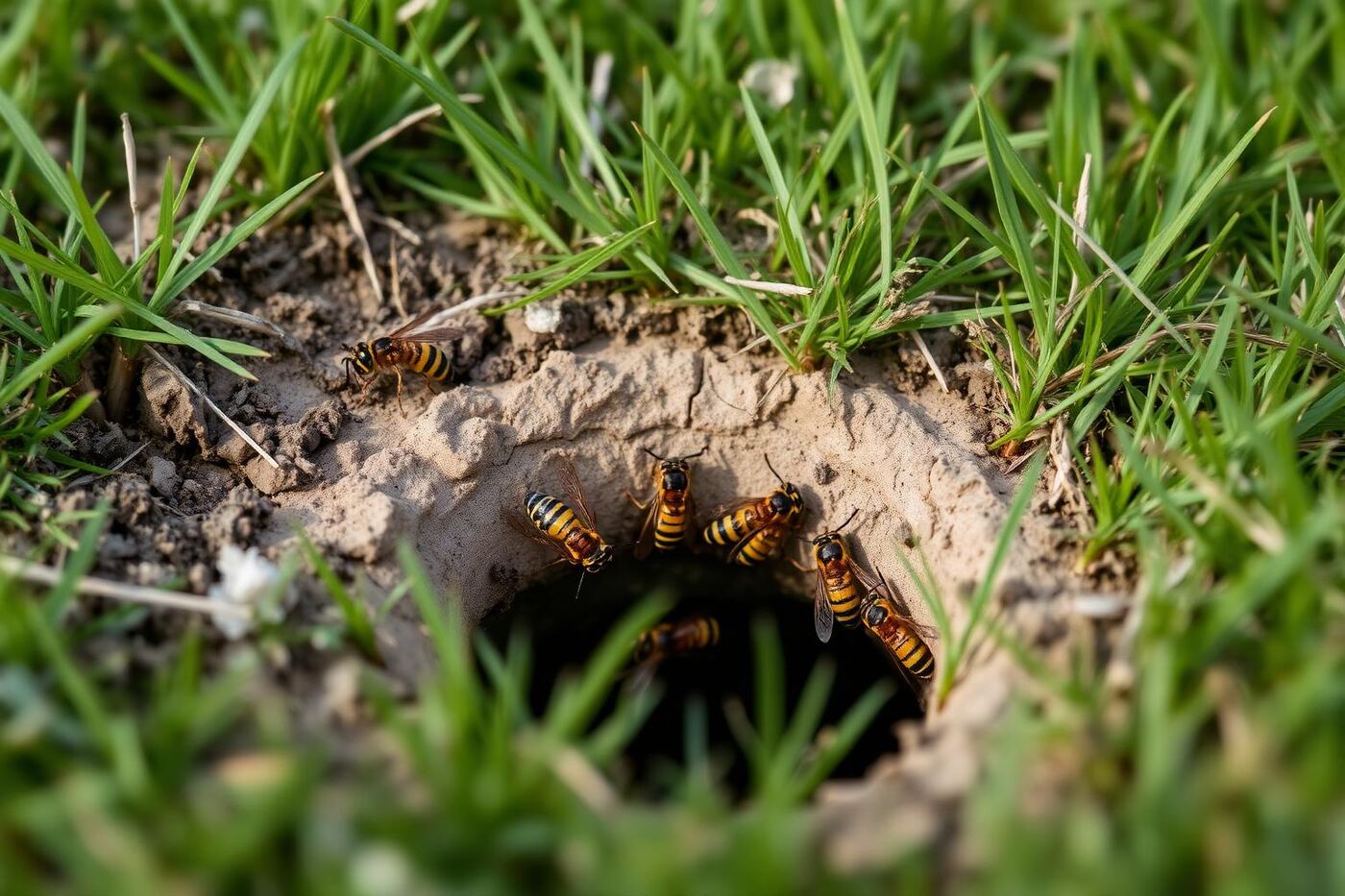
Underground wasp nests account for roughly one in four of the garden jobs we attend in late summer. They go undetected for weeks because there is nothing to see above ground — no papery structure, no swarm — until either the colony hits a few thousand workers and the entrance traffic becomes obvious, or someone strikes the entrance with a mower, fork or strimmer.
How underground wasp nests form
In April and May, queen common wasps prospect for cavities. A disused mouse hole, vole run, abandoned rabbit scrape or even an old molehill system gives her exactly what she needs: a sheltered, constant-temperature void with a single defendable entrance. She chews wood pulp and constructs the first few cells inside the existing burrow. By August the void may contain a nest the size of a football and a colony of 3,000-5,000 workers.
How to identify an underground nest
| Sign | What you'll see |
|---|---|
| A single hole with constant traffic | Stand 5+ metres back and watch for 60 seconds. A steady two-way commute of wasps in and out of one specific hole is conclusive. |
| Bare earth ring around the hole | Wasps clear vegetation and loose soil from the entrance. A small bare patch, 50-100mm across, develops over the season. |
| No visible nest structure | Unlike a shed or loft nest, there is nothing papery to see above ground. The nest itself is 200-600mm down inside the burrow. |
| Wasps flying at lawn height | Persistent low-level wasp activity over one part of the lawn or border, where you'd previously seen none. |
| Aggressive response to garden machinery | Mower, strimmer or rotavator triggers an immediate mass defence — the classic discovery moment. |
The biggest cause of serious stings — garden machinery
Every summer we attend incidents where a homeowner has run a mower or strimmer over a nest entrance they didn't know was there. The outcome is reliably bad: multiple stings to the face, neck and arms within seconds, and a frantic dash for the house with the colony in pursuit. People with no history of allergy have ended up in A&E because the sheer volume of venom from 20-40 stings triggers a systemic reaction.
If you keep a lawn, walk it slowly in late July and early August looking for the bare ring and the entrance hole described above. Mark the spot, stop mowing within 3 metres of it, and call us.
What NOT to do with an underground nest
| Do NOT | Why |
|---|---|
| Pour petrol, paraffin or diesel down the hole | Illegal, dangerous, environmentally damaging, and unreliable. The fuel evaporates without killing the queen. Serious sting incidents result every year. |
| Pour boiling water down the hole | Cools to non-lethal temperatures within the first 200mm of soil. Provokes mass defence at the surface. You will be stung. |
| Block the entrance with soil, a brick or a paving slab | The colony has been expanding the burrow all season — there are usually secondary exits. Returning foragers will become aggressive at the blocked entrance for days. |
| Use an aerosol wasp spray at the hole | Designed for exposed nests, not voids. Insufficient knock-down underground and you are standing at the angry end. |
| Mow, strim or dig anywhere near it | Vibration is the single biggest disturbance trigger for an underground colony. Stay 5+ metres back until treatment is complete. |
How we treat an underground wasp nest
- Identify the entrance from a safe distance — usually obvious from the wasp traffic pattern.
- Apply insecticide powder directly into the hole using a long-reach duster. We do not need to dig.
- Foragers transport powder deep into the nest on their bodies as they enter. The queen is killed within hours.
- Colony inactive within 24 hours. Surface traffic visibly reduces in the first hour and stops by the next morning.
- Backfill the hole after 48 hours with soil. Free revisit if any activity is seen the following week.
Why underground nests come back to the same spot
A successful nest site (a quiet corner of lawn over an old vole run) is attractive to next year's queens too. The papery nest itself is never reused — it disintegrates over winter — but the cavity is. After treatment, backfill the burrow with soil and firm it down to remove the void. This is the only reliable way to stop a repeat the following summer.
Related guides
- Wasp nest in the garden (above ground)
- Signs of a wasp nest
- Wasp stings & allergy — first aid
- Can I remove a wasp nest myself?
- Wasp nest removal cost (UK)