
Loft Nests
Wasp Nest in Your Loft — What to Do, What Not to Do
The most important thing first: do not go into your loft to investigate. Call us on 01727 789571 and we will assess the situation from the outside.
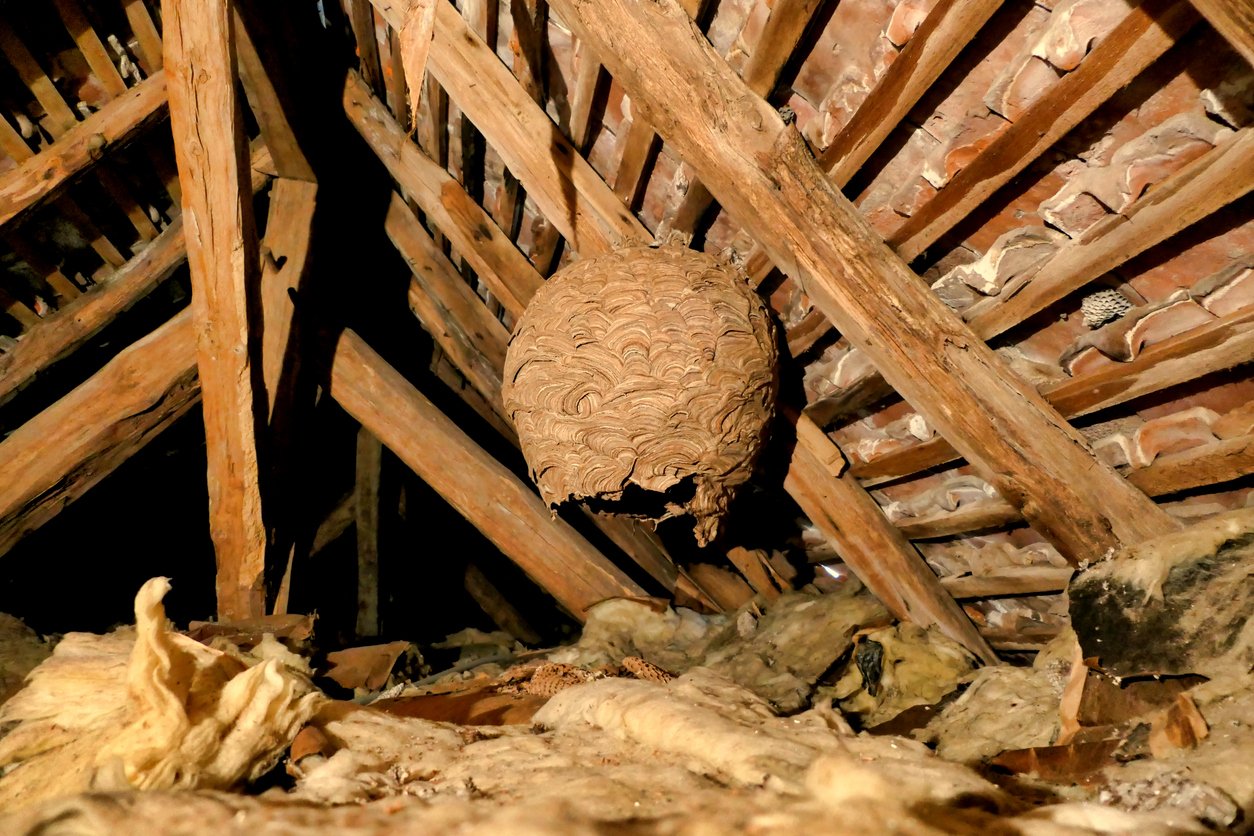
A wasp nest in the loft is by far the most common wasp problem we deal with across Hertfordshire. Lofts are perfect wasp habitat: dark, dry, warm, sheltered, and typically undisturbed for months at a time. A queen finding her way into a loft in April will have built a full football-sized colony there by August before anyone notices.
The good news: we do not need to access your loft to treat the nest. The entire treatment is carried out from the outside via the entry point — no disruption to your home, no protective clothing requirements for you, no risk from entering an occupied loft space.
How to confirm you have a wasp nest in your loft
You almost certainly have a loft nest if you can see one or more of the following from outside the property.
What NOT to do when you have a loft nest
| Do NOT | Why |
|---|---|
| Go into the loft to look at the nest | A loft with an active wasp nest can contain thousands of wasps. Lifting the loft hatch introduces a sudden change in light, air pressure, and vibration that triggers an immediate defensive response. You will be stung. Potentially hundreds of times. |
| Block the external entry point | Blocking the entrance to a live nest traps the colony. Wasps will chew through alternative surfaces to find an exit — often through the loft floor into ceiling spaces, around light fittings, or through junctions in the building fabric. This makes the situation significantly worse. |
| Spray the entry point from the outside | Consumer sprays applied to the outside of the entry gap will kill the wasps immediately at the entrance but not penetrate the nest. The returning foragers, finding their entrance disrupted and smelling the chemical, will be highly agitated. A failed spray treatment makes professional treatment harder. |
| Knock or bang on the ceiling | Vibration is a significant colony trigger. Knocking on the ceiling below an active nest will cause an immediate defensive response from the wasps above — which they will express by trying to find the source of the vibration. |
| Turn on loft lights from inside | If you do enter the loft for any reason, do not turn on the lights with the hatch open. Wasps are attracted to light. The combination of an open hatch and a light source can draw large numbers of wasps toward you rapidly. |
How we treat a loft wasp nest
Our treatment is entirely carried out from the outside. You do not need to clear or prepare your loft. Here is exactly what happens:
- We identify the entry point from the outside. Using the flight pattern of the wasps we locate the exact entry point. In the vast majority of cases this is clearly visible from the ground — a gap at the fascia board, between roof tiles, or at a soffit vent.
- We assess the job and confirm the price. The price is guaranteed at the time of booking and does not change if the nest turns out to be larger than expected.
- We apply professional-grade insecticide powder to the entry point. Using a specialist applicator, we introduce insecticide powder directly at the nest entrance. The returning forager wasps carry this powder into the nest, distributing it throughout the entire colony — including the queen — within a few hours.
- The nest is inactive within 2 to 3 hours in most cases. Activity reduces progressively over the first few hours after treatment. By the following day, the entry point should be quiet.
- We talk you through what to expect. Before we leave, we explain exactly what you will see over the next 24 hours, what is normal (some residual activity as last returning foragers find the treated entrance), and what would indicate the treatment needs following up.
- Free revisit if needed. 97% of nests are resolved in a single visit. If yours requires a second visit, that is always free of charge.
Will the nest cause damage to my home?
This is a common concern. The direct answer is: very rarely, and usually not significantly. Wasp nests do not damage structural timber — the wasps chew dead wood from outside the property to make their nest material, not from your loft. The nest itself is built onto surfaces (rafters, insulation, the loft floor) rather than into them.
In some cases, a very large or long-established nest in direct contact with loft insulation can create localised moisture issues as the nest material absorbs water from condensation over time. This is minor and easily addressed by removing the nest after treatment and checking the insulation beneath.
The one genuine structural risk: if you block the external entry point without treating the nest, the colony may chew through building materials looking for an alternative exit. This is why blocking the entrance to a live nest is so strongly discouraged.
When can you access the loft again?
| Timeframe | What is safe |
|---|---|
| 0–2 hours after treatment | Avoid the loft entirely. Treatment is being distributed through the colony. Activity at the entry point may remain high as foragers return. |
| 2–4 hours after treatment | Activity at the entry point should be visibly reduced. Still avoid the loft. |
| 24 hours after treatment | The entry point should be quiet. If you need access to the loft for an important reason, it is possible with caution — but be aware some wasps may still be present. We recommend continuing to wait. |
| 48–72 hours after treatment | In the vast majority of cases, the nest is completely inactive by this point and loft access is safe. Confirm by checking the entry point from outside first. |
| Physical nest removal | Do not remove the physical nest until you are completely certain the colony is dead — typically at least a week after treatment. Wear protective clothing when removing the nest. |
Loft nests in different property types
Hertfordshire's varied housing stock means loft wasp nest situations vary considerably. Here is what we typically find in each:
| Property type | Typical nest situation |
|---|---|
| Victorian and Edwardian terraces | Original rooflines have numerous small gaps in the mortar and at fascia junctions. Nests typically built directly against rafters or in eaves voids. Entry point almost always at the front or rear roofline. Common across St Albans, Watford, and Hertford. |
| 1930s semis | Boxed-in soffits with gaps at the junction are the most common entry point. Nests frequently establish in the soffit box itself or in the first section of roof void directly behind it. Very common in Marshalswick, Jersey Farm, Hitchin, and Stevenage. |
| 1960s–80s builds | More variable entry points — often around loft ventilation tiles, around pipes or cables, or through gaps in original fascia boards where they have shrunk or warped over time. |
| Modern cavity wall construction | Entry points less obvious and can require more careful observation to locate. Modern properties in London Colney, Chiswell Green, and newer Hatfield developments. |
| Detached properties with larger lofts | Larger loft volumes mean nests can grow to considerable size before any signs are noticed. We have treated some of the largest nests we have ever seen in detached Edwardian and Victorian properties around Harpenden, Berkhamsted, and Clarence Park in St Albans. |
Related guides
- Signs of a wasp nest
- Can I remove a wasp nest myself?
- What happens if you leave a wasp nest?
- Prevention guide
- The wasp life cycle
- Hertfordshire coverage areas