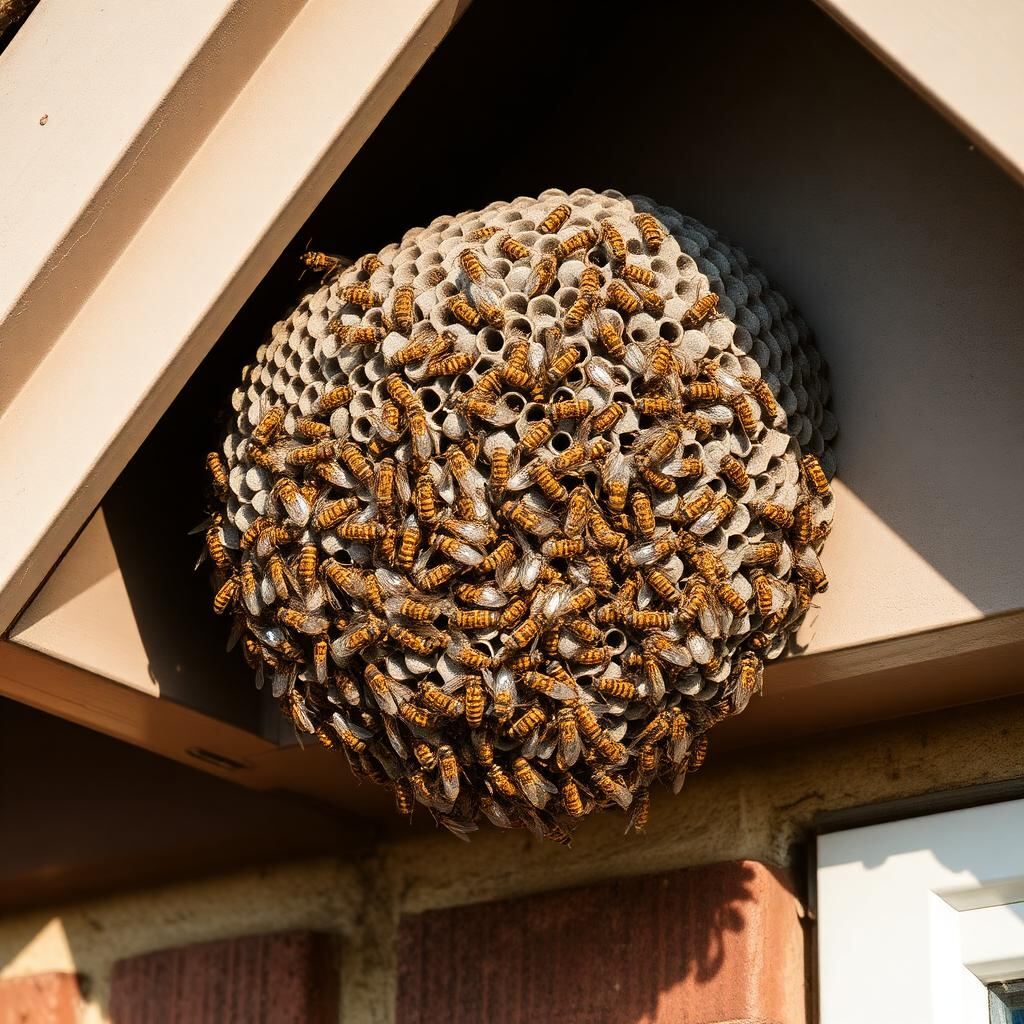
The honest assessment in two sentences. A wasp nest discovered in a safe location in September or October can almost always be left alone — the colony will die naturally within weeks. A wasp nest discovered in June, July, or August near where people live, work, or play should always be treated — leaving it means the colony will grow for weeks more and become significantly more dangerous.
What actually happens month by month if you leave a nest
| Month discovered | What happens if you leave it | Our assessment |
|---|
| May | The colony is small now but doubles in size every 1–2 weeks through June and July. A golf-ball May nest will be a football-sized August nest with 5,000+ workers. You are not avoiding the problem; you are compounding it. | Treat now. Same price, much easier job. |
| June | Same trajectory as May, just one month further on. The nest is growing rapidly every week. | Treat now. Every week you wait the nest grows. |
| July | Peak growth. The nest is likely already large. Every week of waiting means thousands more wasps. | Treat as soon as possible. Do not wait. |
| August | Colony at or near maximum. Leaving it for a few weeks does not significantly reduce risk — the colony will not meaningfully decline until late September at the earliest. | Treat now if near people. Waiting until October is not realistic if the nest is causing a problem. |
| September | Colony starts to decline. New queens dispersing. Workers becoming aggressive. Natural end is 4–8 weeks away. | If the nest is in a low-risk location, waiting is reasonable. If it is near a door, children's area, or access point — treat. September workers are the most dangerous. |
| October (early) | Colony dying down. Activity noticeably reduced from August peak. | Borderline — if still active and near people, treat. If in an isolated location with minimal activity, waiting is reasonable. |
| October (late) | Colony very nearly or completely finished. Workers dying off rapidly. | Leave it. No need for treatment. Seal the entry point once you are certain no activity remains. |
| November onward | Colony dead. Nest abandoned. | No treatment needed. Remove the physical nest at any point when convenient. |
What happens to the nest structure if you leave it
The physical nest, once the colony has died in autumn, is completely harmless. It is an empty paper structure. It will not be reused by wasps next year. Over winter it will absorb moisture and begin to decay. Most outdoor nests largely disintegrate by spring. Indoor nests (in lofts and wall cavities) may survive longer as they are more protected from the elements.
There is no urgent need to remove an old, empty nest. However, there are a few practical reasons you might want to:
- A large, soggy decomposing nest in a loft can eventually cause minor damp issues if left for several years in contact with insulation or structural timber
- Removing the nest and sealing the entry point reduces (but does not eliminate) the chance of a new queen choosing the same location next spring
- Some pests, including certain carpet beetles and clothes moths, are attracted to the remnants of old wasp nests
Situations where leaving a nest is genuinely fine
We want to be clear: not every wasp nest needs professional treatment.
A nest in an isolated tree or hedgerow, well away from where people go. If you have spotted a papery nest at the bottom of a large garden or in a hedgerow along a field boundary, and you can simply avoid that area for the rest of the season, there is no compelling reason to treat it.
A nest discovered in October that is already showing reduced activity. By October the natural decline is well underway. If the nest is not causing immediate problems, waiting four to six weeks for the natural die-off is entirely reasonable.
A small nest in an outbuilding that is not regularly used. A golf-ball sized nest in a shed you visit once a month, discovered in August, can potentially be managed by keeping the shed closed and waiting for the season to end. Whether this is comfortable depends on your personal risk tolerance and whether anyone in your household has a sting allergy.
Situations where leaving a nest is not acceptable
Any active nest near where children regularly play. Children are less aware of wasp behaviour and more likely to inadvertently disturb a nest. The consequences of a mass sting event involving a child are serious.
Any nest where a household member has a known sting allergy. If anyone in your household carries an EpiPen or has had a systemic allergic reaction to a previous sting, there is no safe threshold for risk. Call us.
A nest near any primary entrance to the home. A nest at the front or rear door, near a gate used daily, or at any primary access point creates daily exposure risk for every person entering or leaving the property.
A nest in a loft above bedrooms or living spaces. Nests in loft voids above occupied rooms can sometimes allow wasps to enter the living space through light fittings, ceiling gaps, or ventilation openings. Uncommon but not rare — and completely avoidable.
A nest discovered in June, July, or August in any of the above contexts. The colony has weeks of growth ahead of it. Every week of delay means more wasps, more risk, and the same cost of treatment.
Related guides
Frequently asked questions
Will a wasp nest go away on its own?+
Yes — eventually. Every wasp colony dies naturally in autumn as temperatures drop. But if you discover a nest in summer and simply wait for it to die off, you are looking at several more months of an expanding, increasingly aggressive colony. Whether waiting is acceptable depends entirely on when you found it and where it is.
Will wasps come back to the same nest next year?+
No. Wasp nests are never reused. The physical nest is abandoned in autumn and new queens in spring will build fresh nests. However, the same property or even the same area of a roofline may attract new queens if it proved a good nesting site.
Is it dangerous to have a wasp nest near my house?+
It depends on the location. A nest in a remote corner of the garden away from foot traffic is a different risk level from a nest at your front door or in a loft above a bedroom. The key factors are proximity to where people spend time, whether anyone has a sting allergy, and the time of year.
What if I just keep the area near the nest clear?+
This is a partial risk-reduction strategy but not a reliable one. Wasps will not seek confrontation unprovoked, but the closer people regularly pass to an active nest, the higher the probability of an accidental disturbance and a defensive sting response. In late summer when workers are more aggressive, this threshold becomes even lower.
If I leave the nest and it dies off naturally, do I need to do anything afterwards?+
Seal the entry point once you are certain the colony has completely died off (usually late October or November). This does not guarantee a new nest will not appear nearby next spring, but it removes the path of least resistance. Remove the physical nest at any point — there is no urgency.
Not sure whether your nest needs treating? Call 01727 789571 and describe the situation — we will give you an honest assessment, not a guaranteed sales pitch. Same-day wasp nest removal across Hertfordshire; prices from £99 with a guaranteed price at the time of booking.