
Wasp Nest Removal Hertfordshire logo — stylised wasp iconWasp Nest RemovalHertfordshire

Chimney Nests

Wasp Nest in a Chimney — What to Do

The single most important thing: do not light a fire. Wasp nests are made of dry paper and are highly flammable. Call us on 01727 789571 — we treat chimney nests from the top of the stack in a single visit.
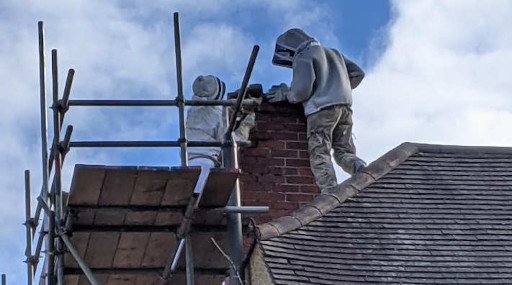
Brick chimney stack with wasps entering and exiting the chimney pot at the top of a Victorian terrace roof

Chimney nests are one of the most common wasp problems we treat on Victorian, Edwardian and pre-war properties across Hertfordshire and North London. An unused chimney is essentially a perfect ready-made cavity — dry, sheltered, dark and ventilated — and a queen wasp looking for nest sites in April will frequently choose one.

How to confirm you have a chimney nest

Wasps flying in and out of the chimney pot. The single most reliable sign. From the garden or street, look at the chimney pot through binoculars — you should see a steady stream of wasps entering and exiting the same pot. Activity is heaviest mid-morning and mid-afternoon at peak season.
Buzzing in the fireplace or chimney breast. Inside the house, a large chimney nest creates an audible low hum heard through the closed fireplace damper or chimney breast wall. This is a confirmed nest above.
Live wasps coming out of the fireplace into the room. Urgent. The nest is in the chimney directly above. Close the door of the room if possible, cover the fireplace opening with a damp sheet, and call us today.

What NOT to do

Do NOTWhy
Light a fireWasp nests are made of dry chewed wood pulp and burn extremely well. A chimney fire is a real risk. Even a small fire will fill the chimney with smoke that drives live wasps down into the room.
Spray bug killer up the chimneyConsumer sprays do not reach the nest body in a chimney — they fall back down into the room. The nest is unaffected and the colony is now agitated.
Block the chimney pot at the topTrapping the colony forces wasps to find an alternative exit, which can mean chewing through old chimney register plates or finding gaps into the room below.
Pour water down from the topDoes not kill the colony, may damage the chimney, and creates a heavy mass of wet nest material that can fall and block the flue completely.

How we treat a chimney nest

  1. We access the chimney pot via ladder, roof ladder or scaffold tower depending on the property. Single-storey extensions and bungalows are quickest; three-storey Victorian terraces take longer to access safely.
  2. Insecticide powder is applied directly into the pot. Returning wasps carry the powder down to the nest, distributing it through the colony within hours.
  3. The colony is inactive within 2-4 hours. Activity at the chimney pot reduces progressively.
  4. Free revisit guarantee. 97% of chimney nests are resolved in a single visit; if yours needs a second, it is free.

Can you use the fireplace afterwards?

Yes — once you are certain the colony is dead (typically a week after treatment), the fireplace is safe to use again. The dry nest material will burn off harmlessly in the first few fires. If you want the physical nest removed before reusing the fireplace, a chimney sweep can remove it after we have confirmed the colony is dead.

Related guides

Frequently asked questions — chimney nests

Why can't I just light a fire to smoke the wasps out?+
Wasp nests are made of chewed wood pulp — essentially dry paper — and are highly flammable. Lighting a fire under a chimney nest can ignite the nest material, create a chimney fire, and force smoke and live wasps into rooms below. Every season we attend properties where this has been tried and made the problem dramatically worse.
Can you treat a chimney nest without going on the roof?+
For most chimney pots access is required at roof level, either via ladder, scaffold tower or roof ladder depending on the stack height. The treatment itself takes a few minutes once at the pot — powder is introduced directly into the chimney pot entrance.
How long does the nest stay in the chimney after treatment?+
The colony is rendered inactive within 2-4 hours. The physical nest itself can be left in place — it does not need to be removed for safety reasons and will not be reused next year. Once active again as a fireplace, the nest material will burn off harmlessly in the first few fires (when there is no live colony).
We have a wood-burner with a flue liner — does that change anything?+
Yes — if you have a stainless flue liner, the nest is almost certainly built inside the liner itself, not on the masonry. Treatment is still from the top of the chimney pot but the wasp activity pattern at the pot will be slightly different. Tell us at the time of booking.
Will the nest cause damage to the chimney?+
No structural damage. Wasps build the nest from chewed-up dead wood collected from outside — they do not chew brick, mortar or flue liner. The nest material itself is dry paper sitting against the chimney walls.
Wasps in your chimney? Call 01727 789571 or 0800 046 3473. Same-day service across Hertfordshire and North London. Fixed price from £99. Free revisit guarantee.

Wasp nest removal across Hertfordshire & North London

Same-day cover in every Hertfordshire postcode and bordering North London boroughs. Pick your town for local pricing, response times and the specific nest situations we see most often in your postcode.

Bordering North London boroughs

Hertfordshire is our priority service area, but we also cover the adjoining North London boroughs from our St Albans base.

Not listed? See the full coverage areas list — over 50 towns across Hertfordshire, Bedfordshire borders and North London.

Got a wasp problem right now?

Call and speak to a real person in Hertfordshire. Guaranteed price at the time of booking. Same-day service in most postcodes.