
from £99
Wasp Nest Removal & Treatment — Potters Bar
Same-day domestic wasp nest treatment across all EN6 postcodes. Professional-grade insecticide powder (PA1/PA6 restricted) applied at the entry point — colony typically inactive within 2-3 hours.
Potters Bar · EN6
Local wasp and hornet pest control across EN6. Family-run, based in St Albans AL3, reaching Potters Bar in approximately 30-40 minutes. Fixed price from £99, PA1/PA6 licensed, free revisit guarantee. Call 01992 827092 — same day WhatsApp for a fast quoteFreephone 0800 046 3473Lines answered 8am till dusk · Mon–Sat · No call-out charge · Free revisit guarantee
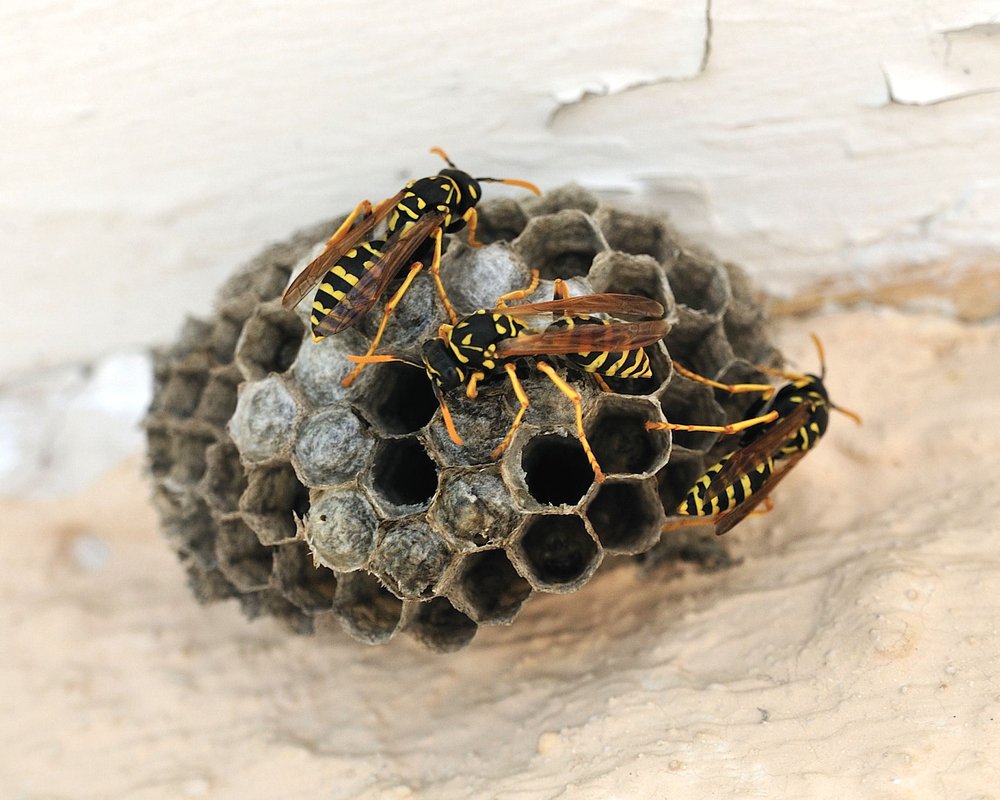
If you have spotted wasps in your loft, found a wasp nest in your roof, or noticed a stream of wasps flying in and out of a gap in your eaves in Potters Bar, you need a qualified local wasp exterminator — not a national call centre. Not sure what you're looking at? Check our guide to the tell-tale signs of a wasp nest before you call.
Potters Bar is our closest service area to North London — many residents commute daily to the city — and it generates a distinct pattern of call-outs. The interwar semis of the town centre produce soffit and fascia nest scenarios typical of 1930s construction. Brookmans Park's substantial detached properties with large, well-planted gardens are among the most consistent producers of underground garden nests and large decking nests in our EN6 coverage. Northaw and Cuffley, sitting on the Green Belt boundary adjacent to Northaw Great Wood, have extremely high queen density — the ancient woodland provides ideal overwintering habitat and properties adjacent to the wood boundary see some of the most frequent annual wasp nest activity in our entire service area.
We cover every street in EN6. If you are searching for a wasp exterminator near you in Potters Bar, you have found us. Tempted to handle it yourself? Read why we strongly advise against it in our DIY wasp nest removal guide, and see what happens if you leave a wasp nest untreated.
01 — Our Services
We specialise exclusively in wasps and hornets. It is all we do — which means we are better at it than any general pest controller juggling rats, fleas and cockroaches alongside the odd wasp job.
Same-day domestic wasp nest treatment across all EN6 postcodes. Professional-grade insecticide powder (PA1/PA6 restricted) applied at the entry point — colony typically inactive within 2-3 hours.
European hornet nests treated using the same method at the same fixed price. Can't tell wasps from hornets? We identify species over the phone in under five minutes.
Call 01992 827092. From our St Albans base we reach Potters Bar in approximately 30-40 minutes.
Restaurants, offices, schools, care homes, landlords and facilities managers. We prioritise commercial call-outs and operate discreetly.
We identify species before sending anyone out. For honey bee swarms we refer to local BBKA-registered beekeepers who often relocate at no charge.
Deep roof voids, underground nests, cavity walls and listed buildings — without invasive work.
02 — Local Knowledge
EN6 wraps around the Green Belt boundary and the Northaw Great Wood ancient woodland — and ancient woodland on your doorstep means a steady annual supply of overwintering queen wasps.
The town centre is dominated by 1930s semis and terraces around Mutton Lane, Darkes Lane and the surrounding streets. Boxed soffits and fascia gaps on this housing stock are the primary nest entry point — a soffit nest is the most common Potters Bar call-out.
Brookmans Park's substantial detached family housing with large gardens produces some of the highest underground garden nest and decking nest frequency in our service area. The Brookmans Park transmitter site open land adds further overwintering habitat to the local mix.
Properties on the boundary with Northaw Great Wood and the Green Belt have exceptional annual nest frequency. The wood provides ideal overwintering habitat for queens and an unending supply of new colonies each spring. Period cottages and Victorian village properties in Northaw and Cuffley also have intact original chimney stacks.
The smaller settlements around Potters Bar — Little Heath, Bentley Heath, South Mimms, Ganwick Corner — have a mix of older properties and modern infill. Outbuilding and garden building nests are particularly common across these areas.
03 — Where We Find Them
The type and location of a wasp nest varies considerably by property age, construction and area. Here is what we most commonly encounter in Potters Bar:
| Nest location | What we find in Potters Bar — and where |
|---|---|
| Soffits and fascia boards | Dominant in Potters Bar town centre interwar housing. Boxed soffits on 1930s semis are the primary nest entry point. |
| Loft / roof void | Present in Brookmans Park 1930s detached properties and Northaw / Cuffley period properties. |
| Chimneys | Northaw and Cuffley period cottages and Victorian village properties; some older town-centre semis. |
| Underground in large gardens | Above average in Brookmans Park; exceptional frequency in Northaw and Cuffley near Northaw Great Wood. |
| Under decking | Brookmans Park and Cuffley larger garden plots particularly prone. |
| Outbuildings, garages and sheds | All areas. Substantial Northaw, Cuffley and Brookmans Park plots particularly common. |
Below is every nest scenario we encounter in Potters Bar, with the specific local context. If your situation isn't listed it almost certainly fits one of these — or call us and describe it.
The single most common Potters Bar call-out. Treated externally at the soffit entry gap — no boards lifted.
Northaw and Cuffley streets bordering the wood see exceptionally high garden nest frequency every season. Treated at the entry hole at dusk.
Brookmans Park's substantial decking installations are a routine nest location. Treated at the edge of the deck — no boards lifted.
Our most common Potters Bar call-out. Treated entirely from the outside via the entry point at roofline level — no loft access required and nothing needs to be cleared from the loft beforehand.
Wasps enter through gaps between or beneath tiles and nest inside the roof void. Powder is applied at the tile-gap entry point from outside — no tiles need to be lifted.
Boxed-in soffits can hide a substantial colony behind a narrow gap. We identify whether the nest is in the soffit void itself or the main roof void from the flight pattern before treatment.
Treated via the chimney entrance. Never light a fire to "smoke them out" — wasp nests are made of dry paper and are highly flammable.
Wasps enter through a loose mortar joint, an open air brick, or a gap around a pipe. Harder to locate but straightforward to treat once the entry point is identified.
A hole in the lawn with low-level wasp traffic is the classic sign. Never block the entrance or pour anything into it; we treat the entry hole with insecticide powder at dusk.
Treatment is applied at the edge of the decking — boards never need lifting. The colony is rendered inactive within a few hours.
Often discovered when the shed door is opened for the first time in summer. Nests typically establish in the roof void or behind cladding.
More common than people expect — and often only spotted from the flight path when gardening nearby. Treated at the visible entry-and-exit point.
Live wasps inside through ceiling light fittings, around the loft hatch or pipework gaps means an established colony is in the roof void directly above. Urgent — do not spray indoors, the nest must be treated at source.
04 — Pricing
No call-out charge. No survey fee. No hidden extras for difficult access, conservation area restrictions or larger-than-expected nests. The price you hear on the phone is the price you pay.
05 — How It Works
A few quick questions to confirm wasps, hornets or bees and to locate the nest. We give you a fixed price and book the earliest convenient slot — usually same day in Potters Bar.
A PA1/PA6 licensed technician identifies the entry point from the wasp flight pattern — no need to access the loft.
Professional-grade insecticide powder applied at the entry point. Carried out externally in almost all cases.
Workers carry insecticide back into the nest, distributing it through the entire colony including the queen. Typically inactive within 2-3 hours.
We explain residual activity to expect and leave you with a direct number in case of any concerns.
97% of Potters Bar nests are resolved in a single visit. If yours requires a return, it is always free — no paperwork, no fuss.
06 — Why Choose Us
Reviews
"Absolutely fantastic service, came the next day after I reached out to John. Very friendly and professional. Removed the wasp nest without issue. If we ever find ourselves with another wasps nest, I'll be certain to contact again."
"John was super responsive, polite, and managed to remove the wasps nest in one go (however he also offered to come back within a few days if there were still wasps). Would thoroughly recommend!"
"John was very fast in responding to my enquiry. He was fast to come to my house to see the problem and deal with it. Very friendly and professional and would 100% recommend his company if you need their services. Thank you again — we are wasp free now :)"
"John came to us in Bushey yesterday to deal with an angry wasp nest on our roof. He was polite, very professional and, as promised, the wasps had all gone before we went to bed. Very happy to recommend."
"John was polite & knowledgeable, he identified the hornet's nest and treated it within an hour — which was quick to work and we haven't seen any hornets since. Also offered to come back if any issues. Would fully recommend."
"I can highly recommend John White of this company. He came very quickly: phoned in the evening & he was there next morning. Very knowledgeable & reassuring. Sorted the problem quickly. Felt I was in very good hands. Checked the rest of my roof while he was here. — Lynne Lloyd, Barnet."
"Called John about a wasps nest in the morning and he came out the same day to sort it out. Great service made easy!"
07 — Coverage
Every street, neighbourhood and village in EN6 is within our daily service zone:
08 — When to Act
| Period | What is happening in Potters Bar |
|---|---|
| Mar — May | Queens emerge and prospect for nest sites. Most early-season sightings are bumblebees, masonry bees or mortar bees — harmless. Genuine wasp colonies are rarely established before late May. |
| June | First genuine call-outs. Colonies are small and easy to treat — same fixed price, faster job, less disruption. Best time to act. |
| July — August | Peak season. Nests can contain thousands of workers. Same-day availability is excellent if you call in the morning. Do not delay. |
| September | Colonies begin to break down. Workers become noticeably more aggressive — September is the most common month for unprovoked stings. |
| Oct — Nov | Colony dies off naturally. Nest abandoned. Seal the entry point after the season ends to reduce risk for next spring. |
For the complete month-by-month guide, see our Wasp Life Cycle page.
08b — Availability
| When | Availability across Potters Bar |
|---|---|
| Monday — Saturday | 8am until dusk. Same-day appointments when you call in the morning. Afternoon and evening bookings available when called by midday. |
| Evenings | Evening appointments on request — useful when external nest access is only practical after work. |
| Weekends | Saturday service at the same fixed price with the same guaranteed result. |
| Sunday | Limited Sunday availability during peak season — call to enquire. |
| Bank holidays | Available on major bank holidays during peak wasp season (June — September). Call to confirm. |
08c — Wasps or Bees?
A significant share of our early-season calls from Potters Bar turn out to be bees, not wasps. This is very common in March, April and May when bumblebees, masonry bees and mortar bees are most active. Our wasp, hornet & bee species guide has side-by-side photos to help you check before you ring.
If we identify honey bees we will not treat them and will refer you to a BBKA-registered local beekeeper who may collect a swarm at no charge. Bumblebee colonies are small, short-lived and harmless; masonry and mortar bees nest individually in soft mortar and cause no structural damage in the short term.
09 — FAQs
10 — Nearby Areas
We cover the whole Hertfordshire and North London region. If you're closer to one of the neighbouring towns below, tap through for the local page — same fixed price, same same-day service.
See our full Coverage Areas page for the complete list of 50+ locations across Hertfordshire and North London.
Call and speak to a real person in Hertfordshire. Guaranteed price at the time of booking. Same-day service in most postcodes.